
We’ve all been there. You get a cheque as payment, deposit it at the bank, and then feel that sinking sensation when you get a notice that it has “bounced.” It’s annoying and can cause actual financial hardship. But what a lot of people don’t know is that in India, the law provides you with a strong means of taking action back if you act fast.
The most important thing to keep in mind here is the cheque bounce case time limit. It’s a race against time. If you miss any of the major deadlines, you may lose your right to legal action, even if you are entirely justified.
This guide will take you through these important timelines in simple, easy-to-understand language, so you are clear on what to do and when to do it.
Why is There a Time Limit? Understanding the “Law of Delay”?
The law governing cheque bounce cases, Section 138 of the Negotiable Instruments Act, is made for speedy justice. The stringent cheque bounce case time limit in India is in place to make sure that:
- Cases are filed immediately while the evidence is still fresh.
- The legal process is not prolonged indefinitely.
- Both sides have a clear and predictable timeline for resolution.
Missing any of these deadlines can cause your case to be dismissed even before it gets to start properly. So let us break down this timeline step-by-step.
Your Action Plan: A Step-by-Step Timeline
Navigating a cheque bounce case is like following a recipe you must add the ingredients in the right order and at the right time. Here’s your step-by-step guide to the cheque bounce case time limit.
Step 1: The First Deadline – Depositing the Cheque
- What to do: You must present the cheque to your bank.
- Time Limit: Within 3 months from the date written on the cheque.
- What happens if you miss it? If you wait longer than 3 months, the cheque becomes “stale.” The bank will not honor it, and you cannot proceed with a legal case, even if the person who gave it to you has sufficient funds.
Step 2: The Trigger – The Cheque Bounces
The bank returns the cheque unpaid. The most common reason is “Insufficient Funds.” The bank will give you a “Cheque Return Memo” explaining the reason for the bounce. Keep this document safe! It is your primary evidence.
Step 3: The Most Critical Step – Sending the Legal Notice
This is where many people get confused. After the bounce, you cannot directly run to the court. You must first formally demand your payment.
- What to do: Send a formal legal demand notice to the person who gave you the cheque (the drawer).
- Time Limit: You have 30 days from the date you received the Cheque Return Memo to send this notice. This is the crucial cheque bounce case legal notice time period.
- What the notice should include: It must clearly state the facts, demand the payment of the cheque amount, and warn that legal action will be taken if payment is not made within 15 days.
Step 4: The Waiting Game – The 15-Day Grace Period
After the notice is served, the law provides the other party with the last opportunity to pay up.
- Time Limit: Within 15 days of receiving your legal notice, they must pay you the amount due in full.
- What happens when they do pay? The case is closed. No case is filed.
- What if they do not pay? This default in payment is what actually constitutes the “offence.” You can now approach the court with a case.
Step 5: The Last Step – Filing the Case in Court
When the 15-day period of grace lapses without payment, your last window of action to raise legal proceedings opens.
- What to do: File a complaint formally in front of a Magistrate.
- Time Limit: You have the next 30 days to file the case. This is the cheque bounce case filing time limit. This 30-day period will commence from the date after the 15-day grace period.
To make it even clearer, here is a visual representation of the whole process and its key deadlines:
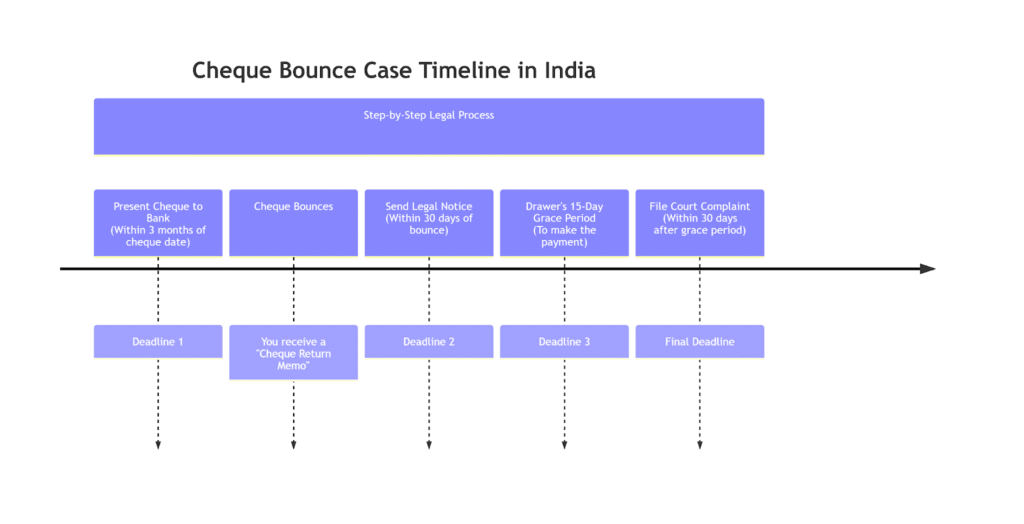
Filing a cheque bounce complaint requires proper documentation, adherence to statutory timelines, and court representation. Working with an experienced cheque bounce case lawyer in Delhi can help you prepare a strong complaint and avoid procedural errors that may delay or weaken your case.
What Happens After the Court Case? The Appeal Stage
At times, a party may not be satisfied with the decision of the court. In this situation, the law allows a party to appeal against this in a higher court.
- Time Limit: The general rule is that the cheque bounce case appeal period is 30 days from the day the lower court orders.
- Important Note: Obtaining an extension of time for this appeal is extremely difficult and is allowed only in rare situations.
Conclusion
It is stressful to deal with a bounced cheque, but the law is in your favor if you move quickly and legally. The whole process depends on the strict cheque bounce case time limit. Knowing and following these deadlines from receiving the cheque to making the case is how you can effectively safeguard your right of money and compel the other person to do the right thing.
Disclaimer: This article is for general informational purposes only and does not constitute legal advice. For professional legal consultation, please visit legalsalhakar.com. All services are provided in accordance with Bar Council of India (BCI) regulations.
Frequently Asked Questions (FAQs)
Can the court extend any of these deadlines if I have a good reason?
Courts have limited power to condone (forgive) delays, but this is not guaranteed. They may accept a delay in filing the court complaint (Step 5) if you have a very strong reason, like a medical emergency. However, delays in sending the legal notice (Step 3) are almost never excused. It's always safest to assume no extension is possible.
The person who gave me the cheque is avoiding receiving my legal notice. What can I do?
This is a common tactic. The law states that the notice must be "sent" to the correct address. If you can prove you sent it via registered post to their official or last-known address within the 30-day limit, you have fulfilled your obligation. If they are avoiding it, the law may presume they have received it.
How long does the entire cheque bounce case take in court?
There is no fixed duration. It can take anywhere from 6 months to several years depending on the complexity of the case and the backlog in the local courts.
Is a cheque bounce case a civil or criminal matter?
It is primarily a criminal offence. If found guilty, the drawer can face punishment including a fine and even imprisonment for up to two years. The court can also order them to pay you the cheque amount.